Psychometric assessments have long been trusted tools for understanding people. They help explain how individuals think, behave, and perform in different environments. Yet for decades, these tools remained largely inaccessible to the people making real decisions every day.
Artificial Intelligence is changing that.
AI is not redefining what psychometrics measures. It is redefining who can use it, how easily it can be applied, and when it can support better people decisions. What was once locked behind certification and complexity is now becoming practical, usable, and timely.
Why Psychometrics Was Traditionally Restricted
Psychometrics earned its reputation through scientific rigor. Assessments were carefully designed, statistically validated, and ethically governed. This rigor came with limitations.
Interpreting results required specialist training. Certification was costly and time-consuming. Reports were often technical and slow to deliver. As a result, psychometric insight was mostly confined to large organizations or external consultants.
Hiring managers, team leaders, and educators were often left to rely on intuition, interviews, or surface-level signals, even when better insight existed.
How AI Is Transforming Psychometric Assessments
AI changes the delivery, not the science.
Modern AI systems can automate scoring, interpretation, and pattern analysis while preserving validated models. Instead of dense reports, users receive structured insight written in clear language and tied directly to real-world decisions.
This enables three critical shifts.
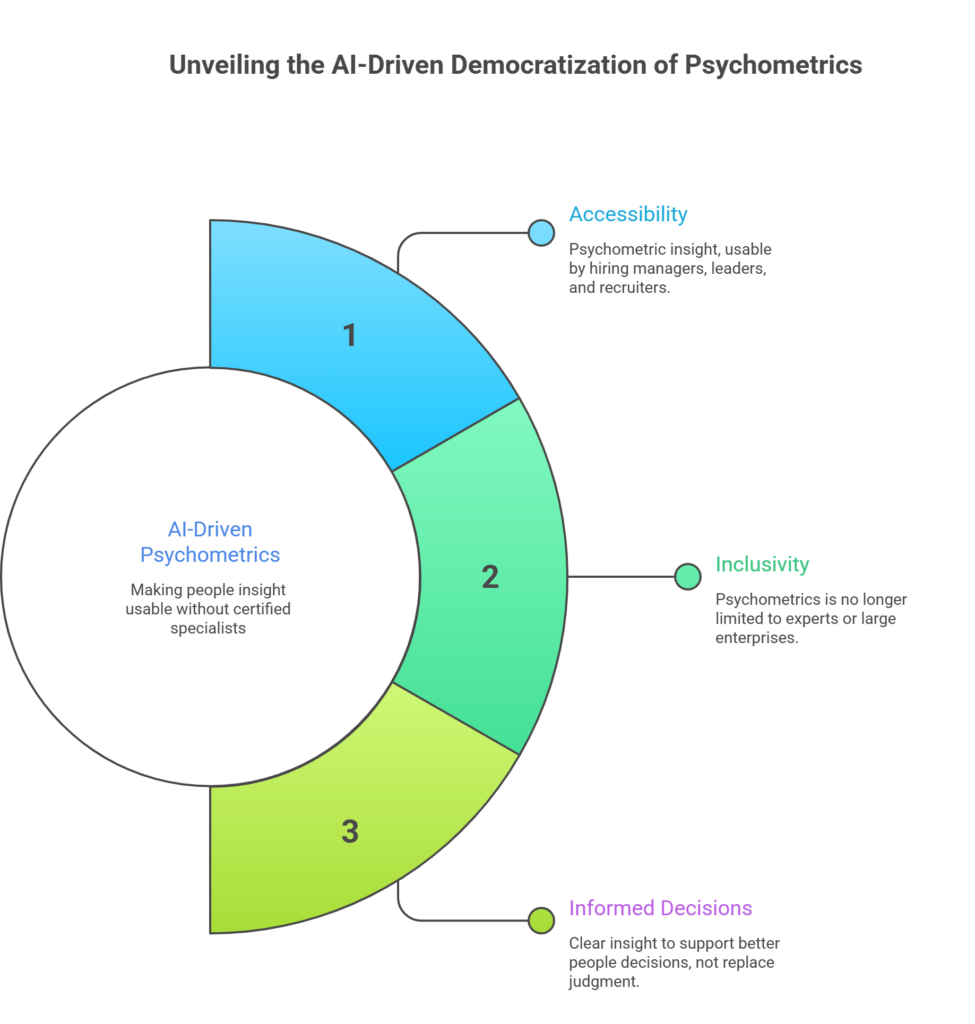
Accessibility: Psychometrics for Everyday Decisions
AI makes psychometric insight usable by hiring managers, leaders, and recruiters.
Instead of requiring specialist interpretation, AI-supported systems guide users through insights in a practical way. This allows psychometrics to support decisions at the moment they are made, not weeks later.
Inclusivity: Beyond Experts and Enterprises
Psychometrics is no longer limited to certified professionals or large corporations.
Smaller teams, growing businesses, and educational institutions can now access validated insight without heavy overhead. This removes long-standing barriers and makes people insight more widely available.
Informed Decisions Without Replacing Judgment
AI does not replace human decision-making. It strengthens it.
Psychometric insight highlights patterns, risks, and alignment, but final decisions remain human. The goal is not automation, but clarity. Better inputs lead to better outcomes.
Responsibility Still Matters
Democratization does not mean lowering standards.
AI-driven psychometrics must handle sensitive data responsibly, monitor for bias, and remain transparent. The most effective systems are built as decision support tools, with humans firmly in control.
Trust is earned through clarity, not complexity.
From Specialist Tool to Practical Support
This shift changes how people decisions are made.
Psychometrics moves from being an occasional, specialist-led exercise to an everyday support mechanism. Hiring becomes more structured. Team building becomes more intentional. Development conversations become more grounded.
Insight becomes part of the workflow, not an afterthought.
A Practical Example of This Shift
One example of this evolution is PERSONA by byteSpark.ai, pioneered through the work of Dr. Ali Raza, in collaboration with professors from Heriot-Watt University, King’s College London, Queen Mary University of London, Rochester Institute of Technology, and Lancaster University.
The aim was not to remove psychometric rigor, but to make it usable without requiring certified specialists. PERSONA applies validated models in a way that supports real decisions while maintaining ethical and scientific grounding.
The Bigger Picture
AI is not weakening psychometrics. It is making it more relevant.
By lowering access barriers while preserving scientific integrity, psychometric insight can finally reach the people who need it most. Hiring becomes more thoughtful. Leadership becomes more intentional. Individuals gain clearer self-understanding.
The democratization of psychometrics is not about replacing humans with technology.
It is about giving humans better tools.