Why this matters now
Organizations are increasingly asked to explain their people decisions.
Not just what decision was made, but:
- Why this person was chosen
- What risks were considered
- What evidence supported the decision
- Whether alternatives were evaluated fairly
Traditional psychometrics were not designed for this level of scrutiny.
AI-driven psychometrics are.
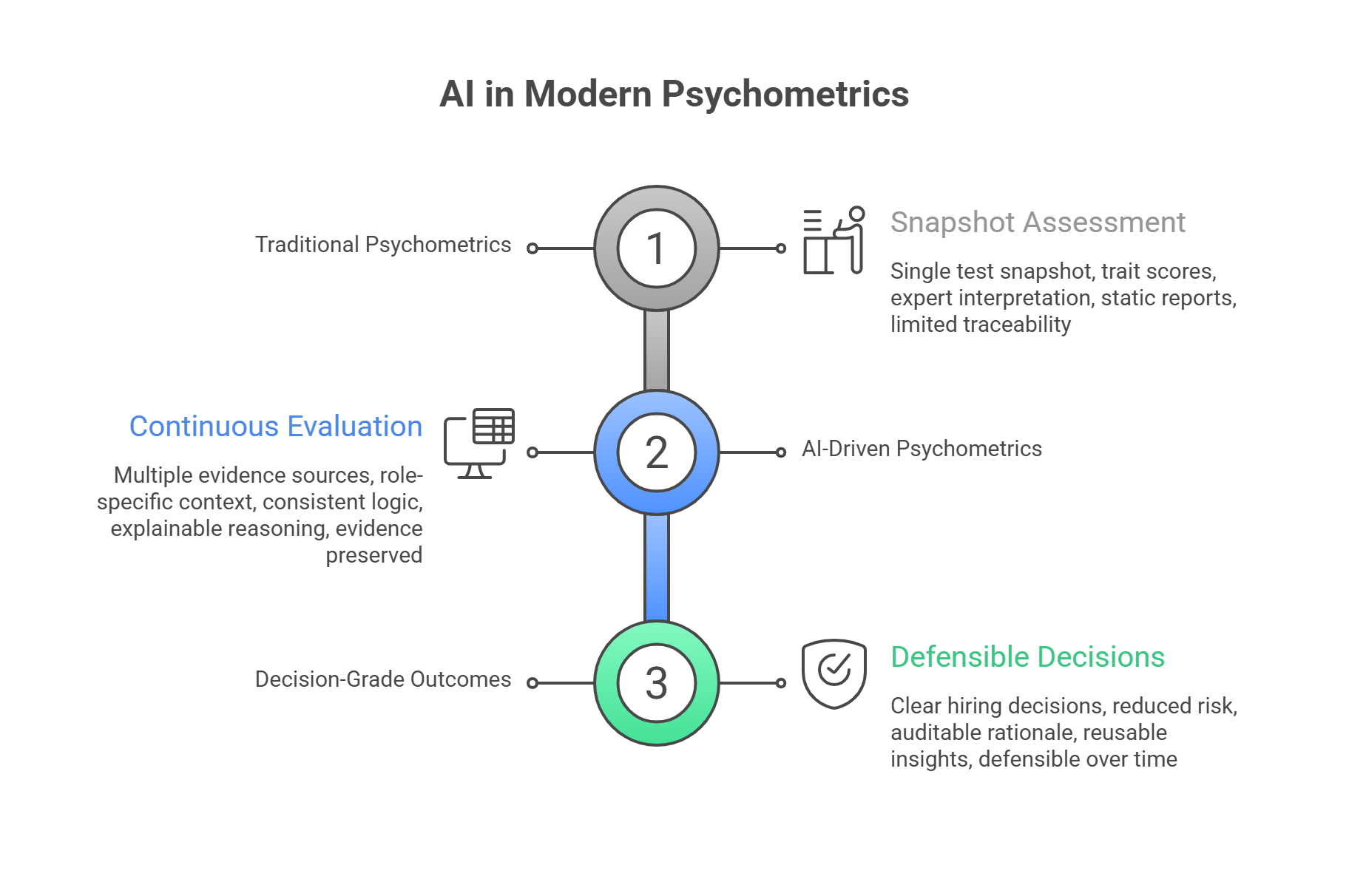
From assessment scores to decision evidence
Most psychometric tools were built to describe individuals.
They produce:
- Trait scores
- Profiles
- Norm-based comparisons
What they rarely produce is decision-ready evidence.
AI changes this by shifting the unit of value from the test result to the decision context.
Instead of asking:
Who is this person?
Modern psychometrics ask:
How does this person reason, respond, and operate in this role, under these conditions?
This aligns directly with how real hiring, promotion, and succession decisions are made.
Using more than one source of evidence
A single test is a fragile foundation for a high-impact decision.
AI-native psychometrics allow evidence to be considered across multiple sources, such as:
- Structured assessment responses
- Role requirements and pressures
- Career history and progression
- Reasoning patterns across scenarios
These signals are not treated equally or blindly.
They are evaluated together, in context, using consistent logic.
This produces a clearer, more grounded view than any single measurement tool can provide.
Reducing evaluation inconsistency
Human judgment is essential, as per standards, but it is not consistent by default.
Two experts can read the same report and reach different conclusions.
The same evaluator can reach different conclusions on different days.
AI reduces this variability by:
- Applying the same evaluation logic every time
- Making reasoning steps explicit
- Ensuring comparable treatment across candidates
This does not remove human oversight.
It removes unintended variation from the process.
Moving beyond dependence on one test or one expert
Traditional psychometrics often depend on:
- A fixed test battery
- A fixed interpretation model
- A certified expert to explain the output
This creates bottlenecks and limits reuse.
AI-driven psychometrics are designed so that:
- Assessments adapt to the role
- Interpretation is built into the system
- Decision makers can engage directly with the output
The result is not less rigor, but more accessible rigor.
Traceability and auditability by design
One of the biggest risks in people decisions is not the decision itself.
It is the inability to explain it later.
AI-native systems are structured to:
- Preserve the evidence used
- Record how conclusions were reached
- Allow decisions to be reviewed over time
This supports:
- Internal governance
- Fairness reviews
- Regulatory and legal scrutiny
- Leadership confidence
Decisions are no longer one-off judgments.
They become reviewable records.
Preserving evidence instead of losing it
In many traditional models:
- Reports expire
- Access is time limited
- Reanalysis requires re-testing
- Every view requires a different assessment
AI changes this by treating assessment data as a long-lived organizational asset.
Evidence remains:
- Available
- Queryable
- Reusable
Organizations can revisit decisions, re-examine assumptions, and apply new lenses without starting from scratch.
What modern psychometrics actually reduce
AI in psychometrics does not remove judgment.
It reduces exposure to:
- Decisions based on isolated signals
- Inconsistent interpretation
- Over-reliance on a single tool
- Loss of evidence over time
- Inability to explain decisions after the fact
This is why modern psychometrics are increasingly described as decision-grade, not just scientifically valid.
Closing perspective
The future of psychometrics is not about smarter tests.
It is about:
- How evidence is assembled
- How reasoning is made visible
- How decisions hold up over time
AI enables this shift by making people decisions clear, structured, and defensible.
That is the real change.