Understanding Standards, Guidance, and Reality
Psychometric assessments are widely used in hiring, promotion, leadership development, and succession planning. Despite this widespread use, there is a persistent and often unchallenged assumption that psychometric tools are formally regulated, certified, or legally governed in the same way as medical devices or financial systems.
This assumption is understandable. Psychometrics feels scientific, authoritative, and consequential. But it is also largely incorrect.
This article clarifies what actually governs psychometric practice today, what professional standards really mean, and why understanding this distinction matters for organizations making people decisions.
The short answer
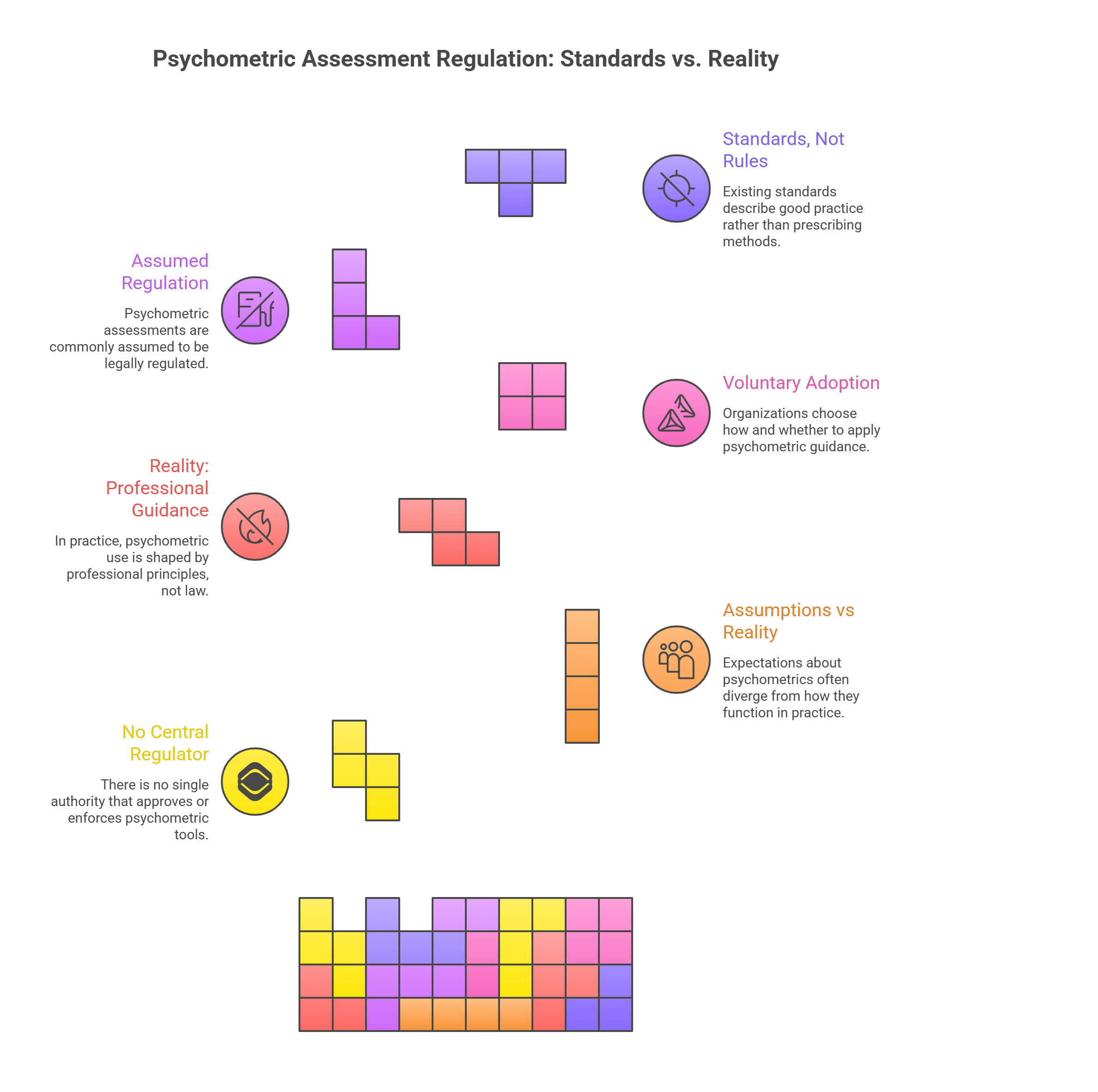
Psychometric assessments are generally not regulated by law.
Instead, they are guided by professional standards and consensus-based principles developed by academic and professional bodies. These standards describe good practice, but they do not function as regulatory frameworks, approval systems, or certification mechanisms.
Why psychometrics is often assumed to be regulated
There are several reasons this misconception persists.
First, psychometric tools are often described using scientific language: validity, reliability, norms, constructs. This creates an implicit association with regulated domains such as medicine or engineering.
Second, some assessment vendors require users to be “certified” before administering their tools. This can look like external regulation, but in most cases it is a commercial or professional gatekeeping model, not a legal requirement.
Third, references to standards bodies are frequently presented without context, leading readers to assume oversight or enforcement where none exists.
What actually exists: professional standards and guidance
The most widely cited reference point in psychometrics is the Standards for Educational and Psychological Testing, developed collaboratively by professional organizations including the American Psychological Association.
These standards are:
- Principle-based, not prescriptive
- Non-binding, not enforceable
- Voluntary, not mandatory
- Focused on interpretation and use, not tool approval
Importantly, these standards do not certify, approve, or license psychometric instruments. They do not grant permission to operate, nor do they prohibit innovation.
The most recent edition of these standards was published in 2014 and remains the current reference point today.
Standards are not regulation
This distinction is critical.
Regulation typically involves:
- Legal authority
- Enforcement mechanisms
- Penalties for non-compliance
- Defined approval processes
Psychometric standards provide none of these.
Instead, they function more like:
- Professional codes of practice
- Ethical guidelines
- Shared academic reference points
They are intended to support responsible design, interpretation, and use, not to dictate specific assessment architectures or technologies.
Why this matters for organizations
Misunderstanding psychometric regulation can lead organizations to make poor decisions in both directions.
Some organizations avoid psychometric tools entirely, fearing legal exposure that does not actually exist.
Others over-rely on legacy tools, assuming that age, familiarity, or references to standards automatically equate to safety or validity.
In reality, responsible use matters more than formal compliance, because there is no regulatory body auditing psychometric decisions after the fact.
The modern gap: new systems, old principles
Most psychometric standards were written before:
- AI-assisted interpretation
- Scenario-based assessments
- Role-specific behavioral risk modeling
- Interactive decision support systems
This does not invalidate the principles. But it does mean that modern systems must interpret and apply guidance thoughtfully, rather than attempting to replicate legacy formats simply because they are familiar.
The relevant question today is not:
“Is this tool regulated?”
It is:
“Is this tool being used responsibly, transparently, and in context?”
Responsible practice without regulation
Responsible psychometric practice typically involves:
- Clear purpose and scope of use
- Transparency around interpretation
- Avoidance of deterministic labeling
- Awareness of bias and misuse
- Use as decision support, not decision replacement
These are matters of design and governance, not regulatory compliance.
Closing perspective
Psychometric assessments are not regulated in the way many people assume. They are guided by professional standards that emphasize good practice, ethical use, and thoughtful interpretation.
Understanding this distinction allows organizations to move past false comfort or unnecessary fear and focus instead on what actually matters: making better, more defensible people decisions in complex, real-world contexts.