Psychometric insight has traditionally been used sparingly. Often late in the process, often by specialists, and often only for senior roles.
Artificial Intelligence is changing that.
Today, organizations are applying AI-powered psychometrics across multiple people decisions, not just hiring. The value is not theoretical. It shows up clearly in how teams reduce risk, improve alignment, and make better decisions when stakes are high.

Based on real customer usage, the following use cases show where AI-powered psychometrics delivers the most impact, and what organizations risk when they operate without it.
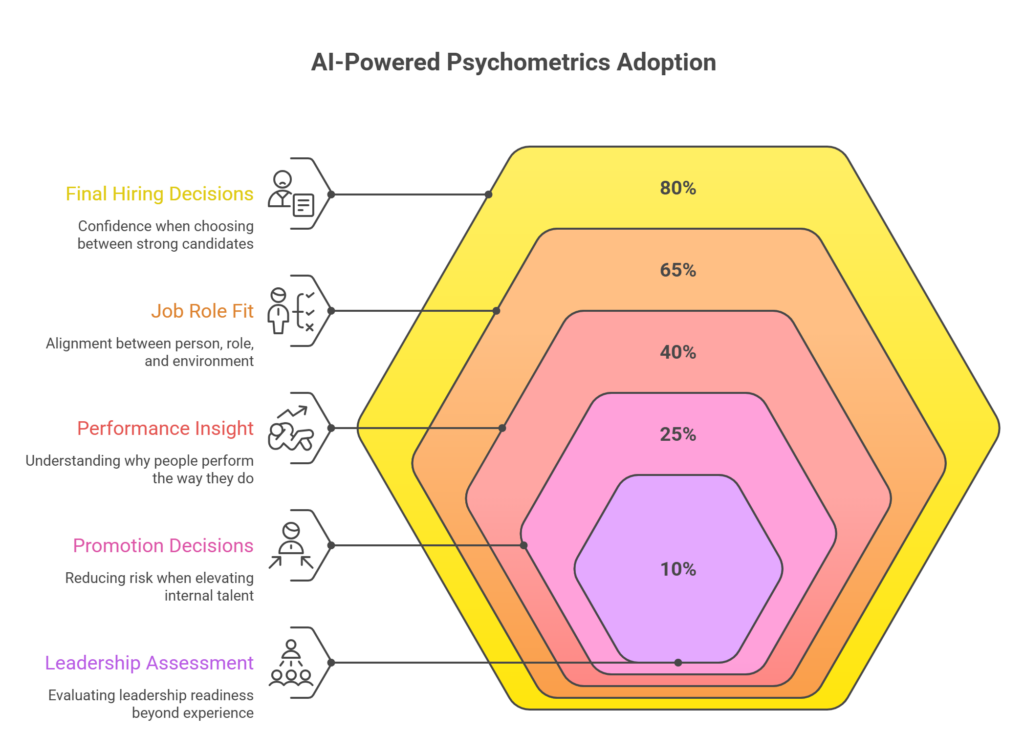
1. Final-Round Hiring Decisions (80%)
This is the most common and highest-impact use case.
By the final stage of hiring, most candidates look strong on paper. Skills are validated. Experience checks out. Interviews are positive. The problem is not finding qualified candidates. The problem is choosing between them.
AI-powered psychometrics helps answer questions interviews cannot reliably surface:
- How does this person handle pressure?
- How do they make decisions?
- How will they work with this specific team?
- Where are the hidden risks?
Value
- Reduces regret after hiring
- Adds structure to subjective decisions
- Helps teams justify choices internally
Without psychometrics
Hiring decisions default to confidence, communication style, or interviewer bias. This is where costly mis-hires happen, even with strong candidates.
2. Job Role Fit and Environment Alignment (65%)
Not every capable person thrives in every role.
Psychometrics helps organizations assess how well an individual aligns with:
- Role expectations
- Work pace
- Autonomy level
- Team dynamics
- Organizational culture
This is especially critical for roles where failure is not due to lack of skill, but misalignment.
Value
- Improves retention
- Reduces early exits
- Sets realistic expectations on both sides
Without psychometrics
Organizations confuse capability with fit. Employees struggle silently, managers misdiagnose issues, and turnover is blamed on performance instead of alignment.
3. Performance Insight and Diagnosis (40%)
Performance issues are rarely one-dimensional.
AI-powered psychometrics helps leaders understand:
- Whether underperformance is structural or personal
- How motivation, stress, and work style impact output
- What kind of support or change is actually needed
Value
- Enables targeted interventions
- Prevents premature performance management actions
- Supports fairer evaluations
Without psychometrics
Performance discussions become emotional, inconsistent, and reactive. Good talent is often lost due to misinterpretation rather than real capability gaps.
4. Promotion Decisions (25%)
Promotion is one of the highest-risk people decisions.
High performers do not always become effective leaders. Psychometrics helps assess readiness for increased responsibility, ambiguity, and people management.
Value
- Reduces promotion failures
- Identifies development gaps early
- Protects both the organization and the individual
Without psychometrics
Promotions are based on tenure or output alone. When promoted employees struggle, the cost is high, both culturally and operationally.
5. Leadership Assessment and Succession (10%)
Leadership assessment is used less frequently, but carries the highest long-term impact.
AI-powered psychometrics supports:
- Succession planning
- Leadership development
- Risk identification in senior roles
Value
- Improves leadership pipeline quality
- Highlights blind spots early
- Supports objective succession discussions
Without psychometrics
Leadership decisions rely heavily on perception, reputation, and visibility. Long-term organizational risk remains hidden until it surfaces as attrition or cultural breakdown.
Why Access to This Data Matters
Across all use cases, the common thread is risk reduction.
AI-powered psychometrics does not replace human judgment. It provides structured insight where intuition alone is unreliable. When access to this data is limited, organizations are forced to guess.
Guessing is expensive.
Looking Ahead
As AI continues to lower barriers to psychometric insight, organizations that embed it into everyday decisions gain a structural advantage. They move faster, decide with more confidence, and reduce avoidable mistakes.
The question is no longer whether psychometrics adds value.
It is whether organizations can afford to make people decisions without it.