Let’s be direct.
Psychometric assessments are not legally regulated in the way most people think they are.

There is no government body that approves psychometric tests.
There is no global authority that certifies them as “legal.”
There is no license that makes a psychometric tool automatically safe to use.

Yet many organizations assume the opposite.

This misunderstanding creates risk.
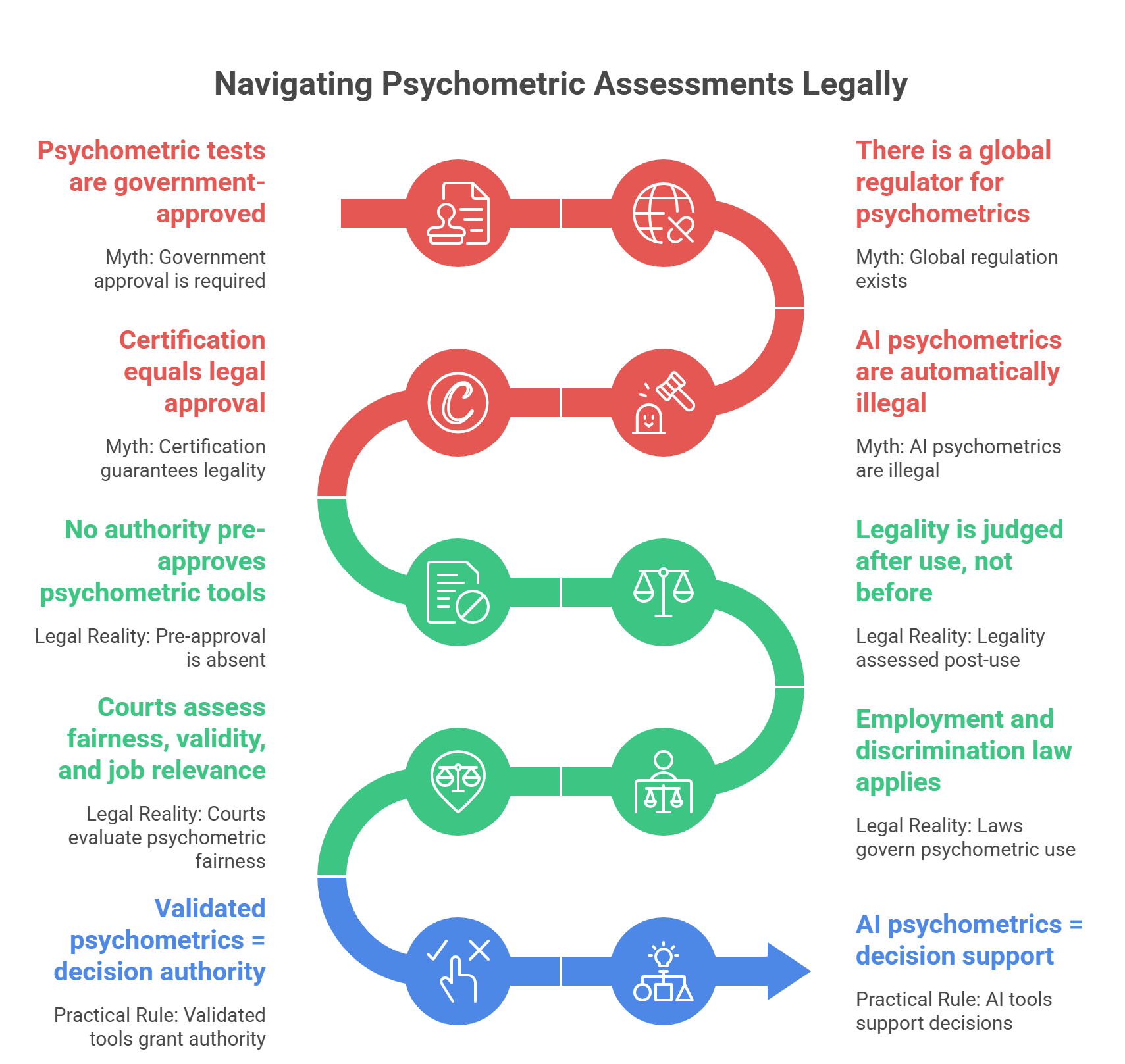
What People Commonly Get Wrong
Most companies believe one of the following:
- Psychometric tools are legally approved before use
- Certification equals legal permission
- AI psychometrics are illegal by default
- Traditional tools are “safe” because they are popular
None of these are accurate.
The law does not work that way.
What “Legally Defensible Psychometrics” Actually Means
A psychometric score is legally defensible only if an employer can justify its use after the fact, if challenged by a candidate, a court, or a regulator.
In plain terms, an employer must be able to say:
“We used this assessment fairly, scientifically, and in direct relation to the job, and it did not unlawfully disadvantage protected groups.”
That is the legal test.
Not branding.
Not popularity.
Not certification badges.
This standard is well established across major jurisdictions Persona Legal Challenge.
What Laws Actually Apply
Psychometrics does not sit under “AI law” first.
It sits under employment and discrimination law.
Typical legal challenges relate to:
- Discrimination (age, gender, nationality, disability, etc.)
- Unfair hiring or promotion practices
- Failure to provide reasonable accommodation
- Automated decision-making without human oversight
Importantly, intent does not protect you.
Courts focus on outcomes, not intentions.
Who Decides If a Psychometric Tool Is Lawful?
This is the most important point.
No authority pre-approves psychometric assessments.
Instead:
- Courts and regulators assess them after use
- Legality is determined by evidence and standards
- Judgment happens when something goes wrong
This applies across regions:
- United States (EEOC, UGESP)
- United Kingdom (Equality Act, tribunals)
- European Union (GDPR, labor law, EU AI Act)
- UAE and Middle East (labor law, anti-discrimination principles, and alignment with EU standards)
Multinational employers often default to UK or EU standards because they are the most defensible globally Persona Legal Challenge.
What Makes a Psychometric Tool Defensible
In practice, defensible tools tend to have:
- Evidence of validity (measures what it claims to measure)
- Evidence of reliability (consistent results)
- Clear job relevance
- Norm groups and benchmarks
- Bias and adverse impact analysis
- Foundations in established psychological models
This is why tools like Hogan, SHL, OPQ, and similar instruments are widely used.
Not because they are perfect, but because they are defensible.
Where AI-Powered Psychometrics Fit Legally
This is where confusion is highest.
AI-driven psychometric tools often:
- Infer traits rather than directly measure them
- Use non-standardized inputs
- Evolve as models change
- Lack published validation studies
Legally, this means:
- High risk if used as the sole decision-maker
- Lower risk when used as decision support
If an AI psychometric score directly decides who is hired, promoted, or rejected, scrutiny is extremely high.
If it informs human judgment, structures interviews, or highlights risk areas, scrutiny is significantly lower Persona Legal Challenge.
The Rule Most Sensible Employers Follow
In practice, many organizations apply a simple rule:
Validated psychometrics = decision authority
AI psychometrics = advisory intelligence
This approach balances innovation with legal safety.
It allows companies to benefit from AI insight without exposing themselves to unnecessary risk.
Plain-English Takeaway
Let’s remove the myths:
- Psychometrics are not pre-approved by law
- Certification does not equal legal permission
- Courts judge tools after use, not before
- Traditional psychometrics are safer because they are proven
- AI psychometrics are powerful, but higher risk if misused
- The law cares about fairness, relevance, and outcomes
Used correctly, psychometrics is lawful.
Used carelessly, any tool can become a liability.