Organizational change forces difficult people decisions.

When companies review performance at scale, especially during restructuring or reorganization, the pressure is not just about deciding what to change. It is about being able to explain and defend those decisions clearly, fairly, and consistently.

This is where many organizations struggle.
The Business Context
In this case, a company was conducting a broad performance review as part of a planned reorganization. Roles were evolving. Teams were being reshaped. Leadership needed to decide where people truly fit in the future organization.
The challenge was not a lack of data. Performance metrics existed. Manager feedback existed. What was missing was contextual insight into people.
The Core Problem: Performance Does Not Equal Fit
Several employees were performing well on the surface, but friction was building underneath.
Leadership faced difficult questions:
- Is this person underperforming, or is the role misaligned?
- Are we seeing a skills gap, or a role design issue?
- How do we justify moving or restructuring someone without it feeling arbitrary?
Without deeper insight, any decision risked being challenged or misunderstood.
Applying AI-Powered Psychometrics for Role Fit
The organization used PERSONA, an AI-powered psychometric framework, to add structure to the review process.
Rather than labeling people as strong or weak performers, the analysis focused on fit between the individual and the role’s real demands.
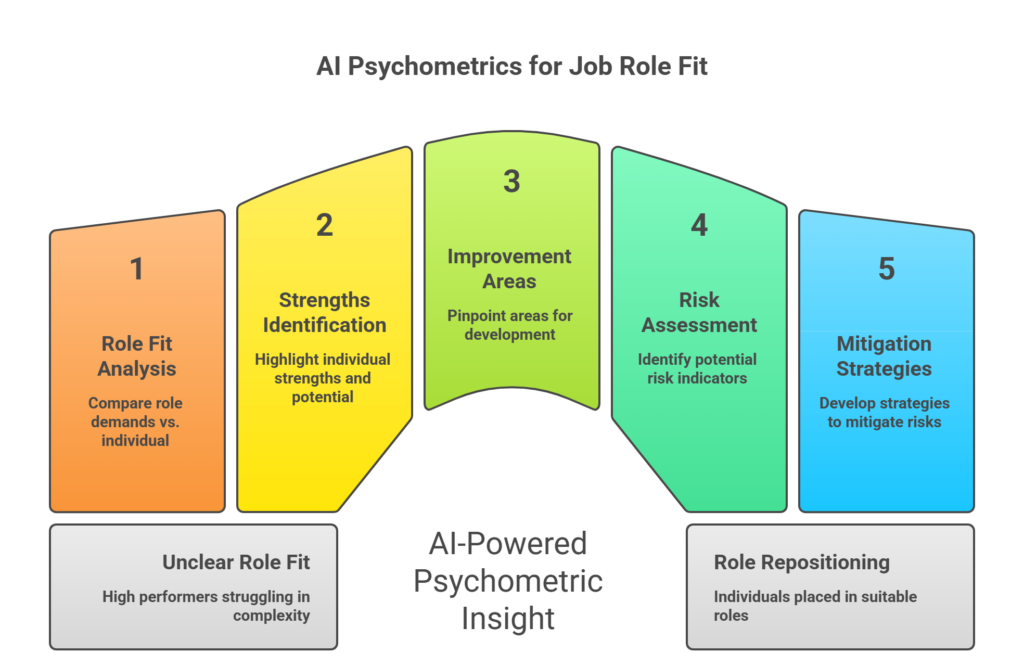
PERSONA helped surface five critical dimensions:
1. Personality Alignment to Role Demands
How the individual naturally operates compared to what the role actually requires.
2. Strengths
Where the person consistently adds value and creates positive impact.
3. Areas for Improvement
Where expectations exceed comfort, energy, or capability.
4. Risk Indicators
Where prolonged misalignment could lead to burnout, disengagement, or operational failure.
5. Risk Mitigation Options
How the organization could reduce risk without losing valuable talent.
This shifted the conversation from judgment to diagnosis.
The Defining Insight
One individual stood out.
He was highly charismatic, confident, and exceptional with customers. Clients trusted him. Deals often closed because of his presence and relationship-building ability.
From a revenue perspective, he was clearly valuable.
However, the psychometric insight revealed something important.
While he excelled in customer-facing interactions, the complexity of managing the full sales operation was misaligned with how he worked. The internal dynamics, process-heavy coordination, and people challenges within that group created friction and stress.
This was not a performance failure. It was a role fit issue.
The Decision: Reposition, Not Remove
Armed with this insight, the company made a different decision.
Instead of forcing the individual to continue in a role that carried increasing risk, they repositioned him to lead pre-sales.
This role:
- Preserved his customer exposure
- Leveraged his natural strengths
- Reduced operational complexity
- Protected both the individual and the organization
Importantly, the decision was defensible. It was backed by structured insight, not opinion.
What Would Have Happened Without This Insight?
Without access to psychometric role-fit data, several negative outcomes were likely:
- Mislabeling a strong contributor as underperforming
- Losing valuable customer-facing talent
- Creating internal resentment or confusion
- Making decisions that felt personal rather than principled
In many organizations, this is exactly how good people are lost during re-orgs.
Why Job Role Fit Matters More During Change
Reorganizations amplify misalignment.
Roles change faster than people do. AI-powered psychometrics gives leaders a way to understand how people can succeed, not just where they currently sit.
It enables decisions that are fair, explainable, and sustainable.
The Bigger Lesson
AI-powered psychometrics does not exist to justify removals.
It exists to find the right place for people to succeed.
When organizations have access to this level of insight, restructuring becomes less about cuts and more about alignment.
That is where long-term value is created.