Leadership succession is never simple.
Replacing a leader who has been in place for 25 years is something else entirely.

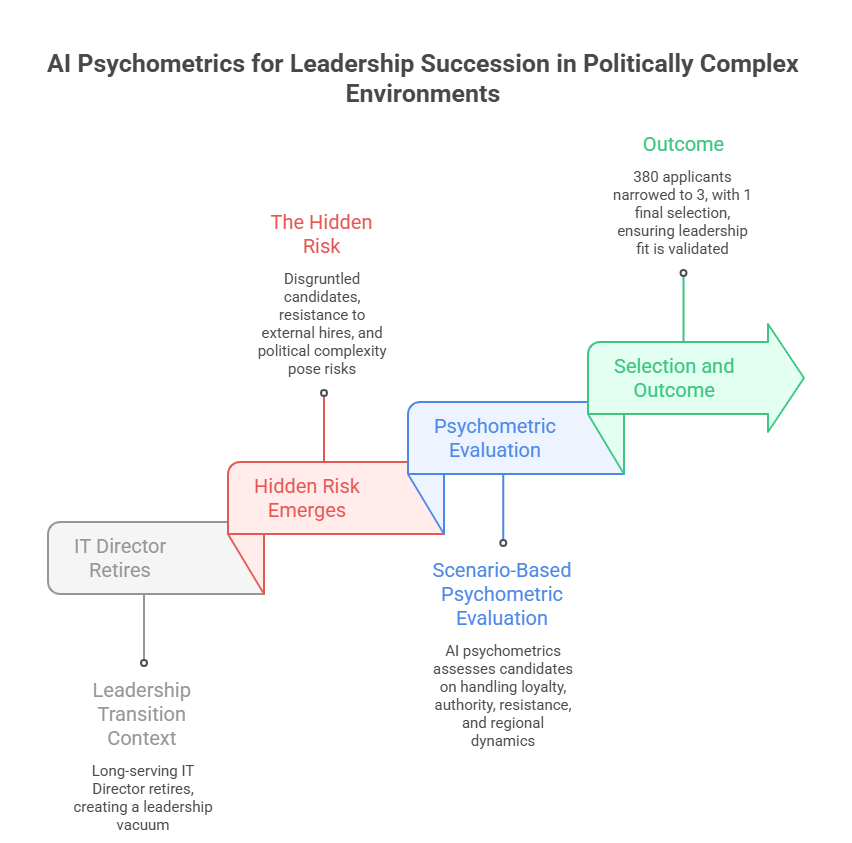
In this case, a company faced the retirement of an IT Director who was not just respected, but deeply trusted. Teams across Saudi Arabia, the UAE, Egypt, and Qatar followed his direction, even when they did not report to him formally.

He carried influence, loyalty, and authority built over decades.

Replacing him was not just a hiring challenge.
It was a political and cultural risk.
The Real Challenge Behind the Role
On paper, the role was clear.
An IT Director with the right technical and managerial capabilities.
In reality, the challenge was far more complex.
The incoming leader would face:
- Teams loyal to a predecessor they deeply admired
- Disgruntled internal candidates who expected promotion
- Senior team members older than the new hire
- Regional and cultural sensitivities across multiple countries
- Authority that would need to be earned, not assumed
No CV or interview could reliably test this.
Why Traditional Hiring Would Have Failed
The recruitment team and CIO understood something critical.
They would only discover whether the new leader could survive this environment after hiring them, when the cost of failure would already be high.
Interviews might reveal confidence.
References might confirm experience.
But none of that answers:
- How does this person handle inherited loyalty?
- Can they lead when authority is informal?
- How do they react when resistance is subtle but persistent?
- Can they unify teams across regions with different expectations?
A Scenario-Driven Psychometric Approach
To address this, the company used PERSONA, an AI-powered psychometric framework, to design a highly tailored evaluation.
This was not a generic leadership assessment.
The evaluation was built around real-world scenarios drawn directly from the company’s environment, including:
- Taking over from a beloved leader
- Managing resistance from senior team members
- Leading teams with dotted-line reporting
- Navigating regional politics and cultural expectations
- Building trust without alienating existing power structures
This shifted the assessment from theory to reality.
Narrowing the Field with Confidence
Nearly 380 candidates applied for the role.
Based on skills and experience, many appeared qualified.
Based on scenario-driven psychometric insight, only three candidates demonstrated the psychological and leadership traits needed to succeed.
From those three, one candidate stood out clearly.
This was not about being the smartest or most experienced.
It was about being most equipped for the situation they would inherit.
Why This Decision Was Different
What made this case unique was not just the shortlisting.
It was the confidence the company gained before making the offer.
Using AI-powered tools within PERSONA, the hiring team was able to:
- Interrogate scenario responses in depth
- Explore risk areas openly
- Ask targeted follow-up questions
- Stress-test leadership assumptions before day one
For the first time, they were not guessing how the candidate would cope.
They could see it.
The Outcome
The selected candidate was offered the role with confidence.
Not because the risk was eliminated, but because it was understood.
The company entered the transition prepared, aligned, and realistic about the journey ahead.
Without this approach, they would have been relying on hope.
Why Scenario-Based Psychometrics Matters
Leadership roles rarely fail due to lack of skill.
They fail because of context.
AI-powered psychometrics, when grounded in real-world scenarios, allows organizations to evaluate not just who someone is, but how they will operate in the environment they are stepping into.
This is where modern psychometrics delivers its greatest value.
The Bigger Lesson
Succession planning is not about replacing people.
It is about protecting trust, culture, and continuity.
When organizations use scenario-driven psychometric insight, they stop reacting to leadership failure and start preventing it.
That is not just better hiring.
That is better governance.