Introduction
Psychometric assessments have long been used to support hiring decisions. One of the most established providers in this space is SHL, known for standardized testing and benchmarking across large talent pools.

However, hiring today looks very different from when many of these tools were designed.

Roles change quickly. Teams are fluid. Hiring managers want answers, not reports. And organizations are increasingly questioning the long-term cost and rigidity of traditional psychometric testing.

This is where PERSONA by byteSpark.ai takes a fundamentally different approach.

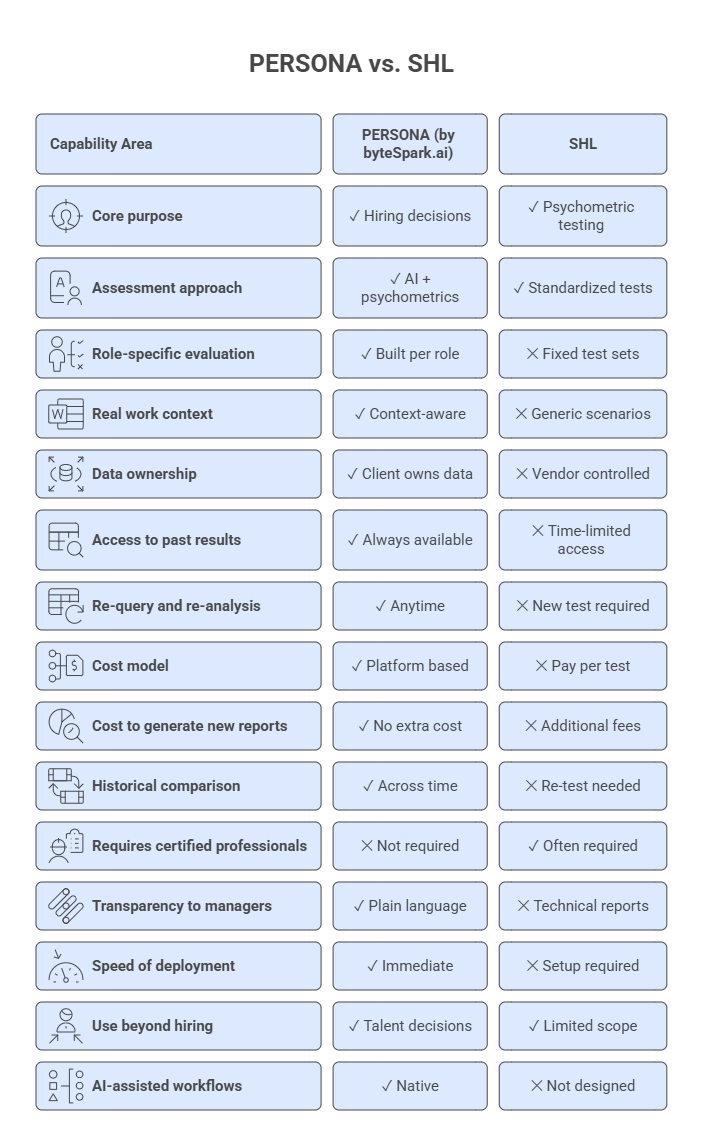
This article explains the differences between PERSONA and SHL across capability, usability, data ownership, and total cost.
What SHL is designed for
SHL is built around standardized psychometric tests.
Its strengths include:
- Large benchmark datasets
- Norm-referenced testing
- Standardized cognitive and behavioral assessments
- Strong presence in enterprise HR
SHL works well when:
- You want consistency across large populations
- You are comfortable with fixed test batteries
- Assessments are used occasionally, not continuously
However, SHL assessments are typically:
- Transactional (pay per test, pay per report)
- Fixed in structure
- Detached from specific role context
Once a test is completed, insight is largely locked into a static report.
What PERSONA is designed for
PERSONA is an AI-native psychometric and decision intelligence system.
It is built for:
- Hiring decisions
- Shortlisting risk reduction
- Internal mobility and promotion decisions
- Ongoing talent conversations
PERSONA does not treat psychometrics as a one-time test.
Instead, it treats assessment data as a living company asset that can be:
- Re-queried
- Re-interpreted
- Compared across roles and time
- Used in different decision contexts
This difference becomes critical when organizations hire frequently or operate in fast-moving environments.
Key differences explained simply
1. Fixed testing vs living intelligence
With SHL:
- Each test is a discrete event
- Each report is generated once
- New insight usually requires a new test
With PERSONA:
- Data remains available to the company
- Reports can be regenerated at any time
- Hiring managers can ask new questions later
This shifts psychometrics from testing to decision support.
2. Vendor-controlled data vs company-owned data
In most SHL models:
- Tests and reports are vendor controlled
- Access may be time limited
- Reuse often means re-payment
With PERSONA:
- Assessment data belongs to the company
- Results remain accessible
- Insight grows over time instead of expiring
This matters for organizations that want continuity, learning, and institutional memory.
3. Specialist interpretation vs manager clarity
SHL reports are:
- Technically sound
- Often difficult for non specialists
- Commonly interpreted by trained professionals
PERSONA outputs are:
- Written in plain language
- Structured around decisions and risks
- Designed for direct use by hiring managers
This reduces dependency on external experts and speeds up hiring.
Pricing and total cost of ownership (critical difference)
This is where many organizations experience the biggest gap.
SHL cost model (typical experience)
SHL generally operates on:
- Pay per test
- Pay per report
- Ongoing fees for continued usage
- Additional costs for re-testing or re-analysis
Over time, this means:
- Costs increase as hiring volume increases
- Insight cannot be reused freely
- Budget is tied to transactions, not value
Organizations often hesitate to re-test or re-analyze due to cost.
PERSONA cost model
PERSONA operates on a platform model.
This means:
- Assess once, use many times
- No charge for re-querying past data
- No charge for generating new reports
- No per-test penalties
Hiring teams are encouraged to:
- Revisit assessments
- Compare candidates later
- Use the same data for multiple decisions
Cost comparison in real terms
Feedback we consistently hear from clients is:
- PERSONA delivers more actionable insight than traditional tools
- Total cost is often around one third of comparable SHL or Hogan usage
- Value increases over time instead of resetting
This is not because PERSONA is “lighter”, but because it removes:
- Transactional pricing
- Specialist dependency
- Repeated testing costs
When SHL may still make sense
SHL can be a good fit when:
- You need standardized benchmarking at scale
- Testing is infrequent
- Budget is not tied to hiring velocity
- You are comfortable with fixed outputs
When PERSONA is the better fit
PERSONA is a better fit when:
- Hiring is continuous
- Roles are evolving
- Managers want clear answers
- You want to reduce people risk
- You want insight without repeated cost
Final thought
SHL is a testing provider.
PERSONA is a decision intelligence platform.
Once organizations experience the difference between paying for tests and owning insight, the choice often becomes clear.