Promotion decisions are some of the most sensitive choices organizations make.

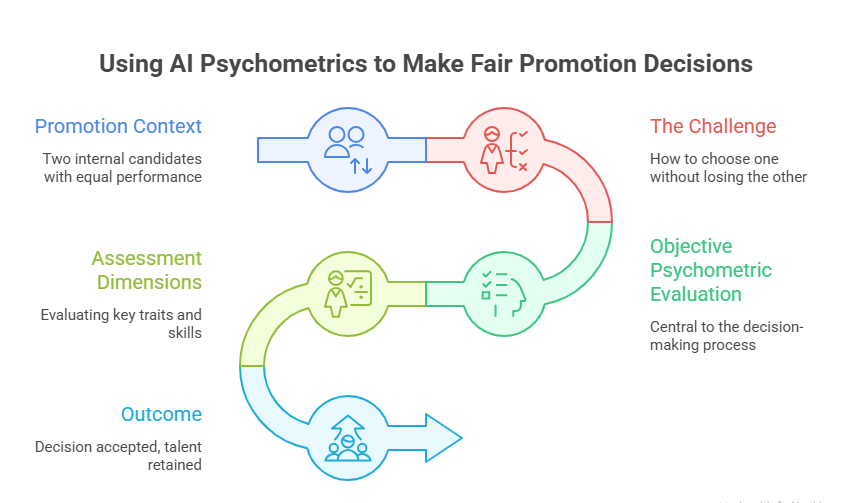
In this case, a company faced a situation that many leaders quietly dread. Two internal candidates were being considered for a promotion, and by every traditional measure, they were almost identical.

Performance ratings were strong for both.
Years of service were comparable.
Compensation levels were aligned.

There was no obvious, defensible reason to choose one over the other.
The Risk Beneath the Decision
The company understood the real risk was not just choosing the wrong person. It was losing trust.
If Candidate A was rejected without clear reasoning, disengagement was likely.
If Candidate B was promoted without transparency, resentment could follow.
In the worst case, the organization could lose two strong contributors instead of gaining one leader.
A Different Approach to Promotion
Rather than framing the decision as a competition, leadership took a deliberate step back.
Both candidates were told clearly:
- You are both strong
- This decision is not about tenure or past performance alone
- We need an objective assessment beyond experience and qualifications
The company explained that leadership roles require different capabilities, including:
- Working and thinking style
- Collaboration and influence
- Leadership under pressure
- Assertiveness without alienation
- Decision-making in complex situations
- Ability to bring people along
- Navigating organizational dynamics and internal politics
These dimensions are rarely evaluated well through interviews alone.
Applying AI-Powered Psychometric Evaluation
All relevant context was provided to PERSONA, which was used to design a tailored psychometric evaluation specifically for this promotion scenario.
The same evaluation was sent to both candidates.
This was critical.
Both individuals were assessed against the same expectations, the same role demands, and the same leadership criteria. There was no subjective adjustment or hidden weighting.
What the Evaluation Revealed
The results were clear.
Both candidates had strong foundations, but differences emerged in:
- Leadership style
- Decision-making approach
- How each would manage people reporting to them
- Comfort with ambiguity and conflict
- Ability to operate within the political realities of the organization
These were not framed as strengths versus weaknesses, but as fit versus role demands.
The Outcome: Clarity Without Conflict
Candidate B was selected for the promotion.
Candidate A, having full visibility into the evaluation, understood why. The gaps identified aligned with feedback they already suspected but had never seen articulated clearly.
Most importantly:
- The decision did not feel personal
- It did not feel arbitrary
- It did not feel political
Candidate A accepted the outcome, acknowledged the areas for development, and chose to step aside with professionalism and dignity.
The organization retained both individuals.
What Would Have Happened Without This Approach?
Without objective psychometric insight, the likely outcomes were far riskier:
- A decision perceived as favoritism
- Loss of trust in leadership
- Quiet disengagement or eventual attrition
- Damage to team morale
Promotion decisions often fail not because the wrong person is chosen, but because the process lacks transparency.
Why This Matters for Internal Mobility
As organizations grow, internal promotions become more common and more complex.
AI-powered psychometrics allows companies to:
- Make defensible promotion decisions
- Protect internal relationships
- Encourage healthy development conversations
- Retain high-performing talent even when not promoted
This is not about removing human judgment.
It is about making judgment explainable.
The Bigger Lesson
When promotion decisions are handled with clarity and fairness, outcomes improve for everyone.
AI-powered psychometrics does not just help select leaders.
It helps organizations keep trust intact while doing so.