Introduction
For decades, psychometrics has relied on standardized trait measurement. These tools brought structure, comparability, and legal defensibility to hiring and talent decisions. They remain deeply embedded in high-stakes environments for a reason.

However, they are no longer sufficient on their own.

Organizations today operate in conditions that standardized trait models were never designed to fully capture: complex roles, cross-functional influence, political dynamics, rapid change, and situational leadership challenges.

The future of psychometrics is not about abandoning standards. It is about moving beyond them.
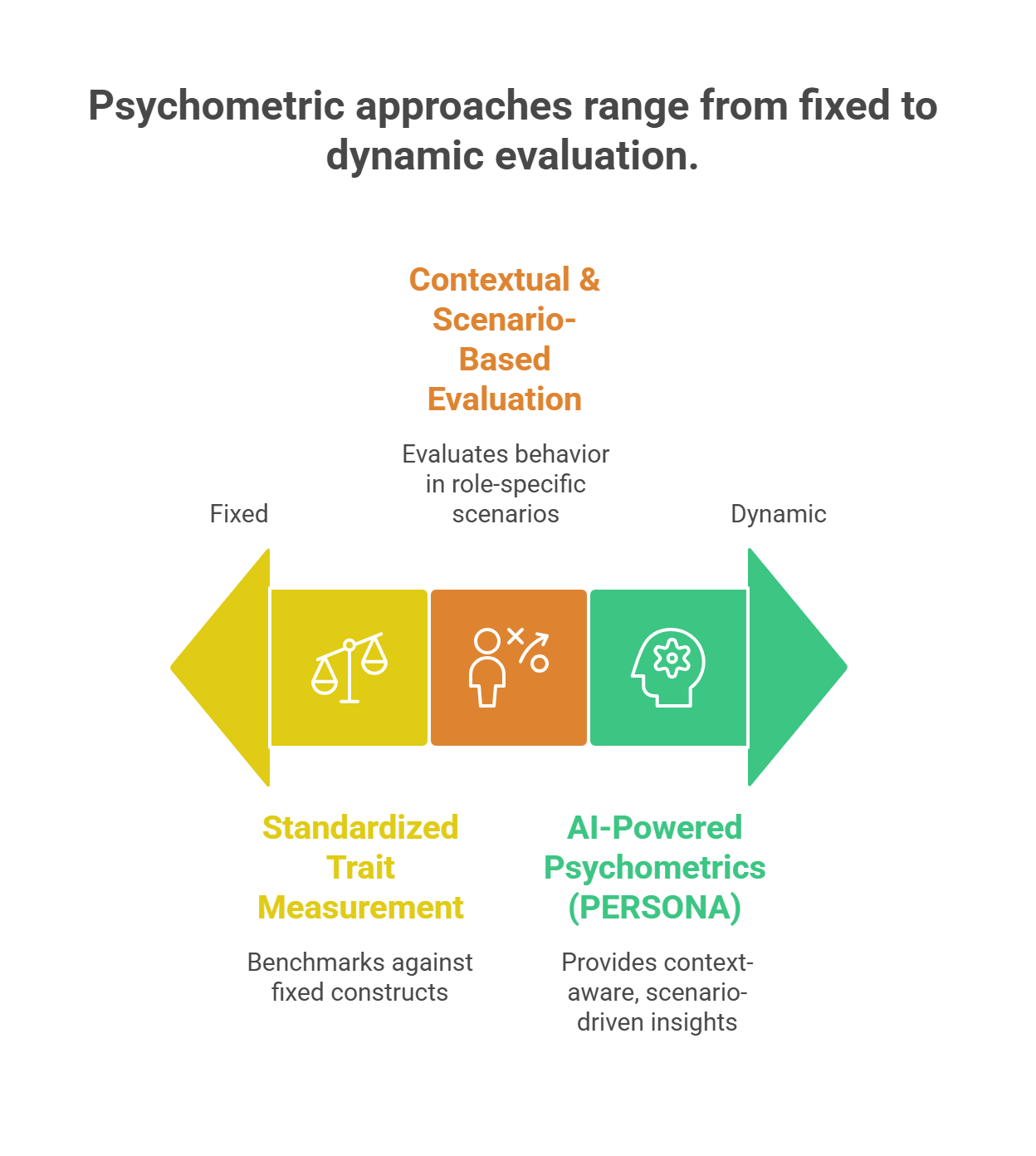
What Standardized Trait Measurement Really Provides
Standardized psychometric tools measure predefined psychological constructs using fixed questions and stable scoring models. They produce comparable scores across individuals and populations and are benchmarked against norm groups.
This approach offers three critical advantages:
- Consistency across candidates and time
- Demonstrable reliability and validity
- Strong legal defensibility in high-stakes decisions
This is why standardized tools continue to dominate regulated, executive, and safety-critical environments.
They are predictable, auditable, and explainable.
What Standardized Trait Measurement Provides
Standardized psychometric tools measure predefined psychological constructs using fixed questions and stable scoring models. They produce comparable results across individuals and populations and are benchmarked against norm groups.
This approach offers three critical advantages:
- Consistency across candidates and time
- Demonstrable reliability and validity
- Strong defensibility in high-stakes decisions
This is why standardized tools continue to dominate regulated and executive environments. They are predictable, auditable, and easy to explain.
The Structural Limits of Trait Standardization
Despite their strengths, standardized trait models have inherent limitations.
Human behavior is highly sensitive to context. The same individual can behave very differently depending on role demands, organizational culture, power structures, and situational pressure. Fixed trait scores flatten this reality.
As a result:
- Situational nuance is lost
- Growth potential is underestimated
- Role-specific risk remains hidden
- Complex leadership dynamics are reduced to static dimensions
Trait models provide stability, but they do so at the cost of resolution.
Why Context Matters in Modern Organizations
Modern organizations are distributed, political, and fast-moving. Leadership increasingly requires influence without authority, decision-making under ambiguity, and the ability to navigate inherited loyalties and informal power.
These conditions cannot be meaningfully evaluated through standardized trait scores alone.
What matters is not only who someone is, but how they respond to specific, real-world situations.
The Role of AI in the Next Generation of Psychometrics
AI-powered psychometrics enables a shift from static measurement to contextual evaluation.
Rather than standardizing individuals against generic trait benchmarks, AI allows evaluations to be structured around:
- Role-specific scenarios
- Behavioral responses under pressure
- Patterns of judgment and decision-making
- Alignment with situational demands
This does not replace psychometric science. It extends it.
When used responsibly, AI functions as decision support, helping humans ask better questions and surface hidden risk, rather than acting as a final authority.
The Future Is Hybrid, Not Binary
The evolution of psychometrics is not a choice between standardized traits and AI.
The most robust approach combines both:
- Standardized measures provide governance, comparability, and defensibility
- Contextual, scenario-based AI evaluations provide depth and relevance
- Human judgment retains ethical responsibility and accountability
This hybrid model is already emerging in advanced organizations.
Where PERSONA Fits
PERSONA by byteSpark.ai was designed for this next phase of psychometrics.
Rather than standardizing individuals against abstract traits, PERSONA focuses on contextual, scenario-based evaluation grounded in real organizational challenges. It helps decision-makers understand how individuals are likely to behave within the environments they will inherit.
PERSONA does not attempt to replace standardized psychometrics where they are required. It complements them by addressing what traditional models cannot capture.
This is not a rejection of rigor. It is an evolution of it.
Strategic Implications for Organizations
Organizations that rely solely on standardized traits will remain defensible, but increasingly blind to situational risk.
Organizations that adopt contextual, scenario-based psychometrics gain:
- Better alignment between people and roles
- Earlier detection of leadership risk
- Stronger promotion and succession decisions
- Greater confidence in complex environments
The future of psychometrics is not more scoring.
It is better understanding.
Closing Perspective
Standardized psychometrics will continue to play a critical role in accountability and governance. They are unlikely to disappear.
However, insight must evolve alongside organizational complexity.
The next generation of talent decision-making will be defined by contextual, scenario-driven psychometric intelligence, supported by AI and guided by human judgment.
That is where the field is moving.
And that is where PERSONA is positioned.