
Psychometric tools were never designed to replace judgment. They were designed to reduce risk.
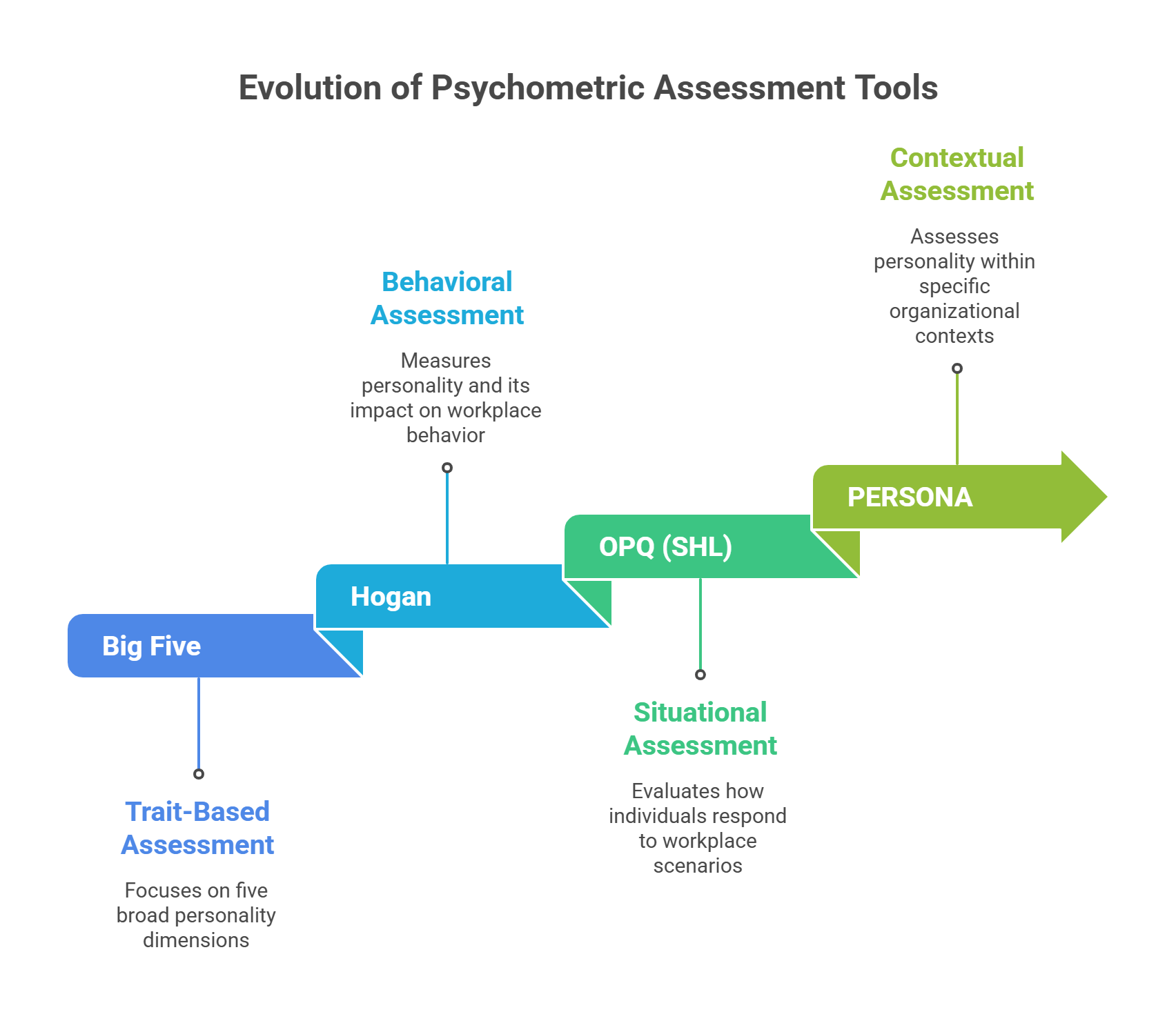
Over the past several decades, three frameworks have dominated organizational psychometrics: Big Five, Hogan, and OPQ. Each solved a specific problem of its time. Each remains valuable today.
However, organizations now operate in environments these tools were not designed to fully address. Roles are more complex, leadership is more contextual, and success is shaped as much by situation as by stable traits.
This is where a new generation of psychometrics, represented by PERSONA, emerges.
Big Five
Descriptive, Scientific, and Legally Understandable
The Big Five model describes personality using five broad dimensions: Openness, Conscientiousness, Extraversion, Agreeableness, and Emotional Stability.
Its greatest strength is scientific consensus. It is stable across cultures, widely researched, and easy to explain in legal or academic contexts.
Its limitation is equally clear. Big Five describes people in general terms. It does not translate naturally into role performance, leadership behavior, or situational response.
Big Five explains variance. It does not explain outcomes.
Best use: Foundational understanding of personality
Weakness: Low role and situational specificity
Hogan
Leadership Risk and Derailment Under Pressure
Hogan builds on trait psychology but reframes it for corporate leadership. Its focus on derailers under stress is one of the most valuable contributions to executive assessment.
Hogan excels at identifying how strengths can become liabilities when pressure increases. Boards and succession committees value this perspective.
However, Hogan is inherently static. It assumes relative trait stability and places heavy emphasis on interpretation. Two professionals can reasonably reach different conclusions from the same profile.
It is strong at predicting failure risk. It is less strong at predicting upside or contextual success.
Best use: High-stakes leadership risk assessment
Weakness: Static and interpretation-heavy
OPQ (SHL)
Role Alignment at Scale
OPQ shifts the focus from who someone is to how they work. It maps behavioral preferences directly to job competencies, making it highly effective for structured hiring at scale.
It is defensible, operationally efficient, and integrates well into enterprise hiring systems.
Its trade-off is depth. OPQ tells you how someone is likely to behave, but not why, and not how that behavior may change under pressure or political complexity.
Best use: Operational hiring and role alignment
Weakness: Limited insight into leadership nuance
PERSONA
Contextual, Scenario-Based Psychometrics
PERSONA represents a different direction.
Rather than standardizing individuals against fixed traits, PERSONA evaluates how individuals respond to real-world scenarios within specific organizational contexts. It is designed for environments where role success depends on ambiguity, influence, politics, and change.
PERSONA does not treat traits as universal truths. It treats behavior as contextual, situational, and dynamic.
Key differentiators include:
- Scenario-based evaluation rather than abstract traits
- Role-specific psychometric design
- Insight into risk, mitigation, and development
- AI-supported interrogation rather than static scoring
- Decision support instead of rigid decision authority
This approach reflects the direction of modern research and applied organizational psychology, as explored in byteSpark.ai’s work on democratizing psychometrics and contextual evaluation.
Best use: Complex roles, leadership transitions, promotions, and high-stakes decisions
Strength: High contextual relevance and human nuance
Head-to-Head Summary
| Dimension | Big Five | Hogan | OPQ | PERSONA |
|---|---|---|---|---|
| Scientific foundation | High | High | High | High |
| Legal defensibility | High | Very High | Very High | Very High (as decision support) |
| Role relevance | Low | Medium | High | Very High |
| Leadership insight | Low | High | Medium | Very High |
| Context sensitivity | Low | Medium | Low | Very High |
| Scalability | Medium | Low | Very High | High |
| Human nuance | Medium | High | Low | Very High |
| Static vs dynamic | Static | Static | Static | Dynamic |
| Decision authority | Baseline | Risk filtering | Operational fit | Decision support |
What This Comparison Really Shows
These tools are not competitors in a zero-sum sense. They reflect different eras and priorities in psychometrics.
- Big Five prioritizes scientific clarity
- Hogan prioritizes leadership risk
- OPQ prioritizes operational alignment
- PERSONA prioritizes contextual understanding
The evolution is not about replacing legacy tools. It is about addressing what they cannot.
The Direction of Travel
Organizations are increasingly combining:
- Defensible standardized measures
- Contextual, scenario-based AI insight
- Human judgment and accountability
PERSONA was designed for this reality.
It does not claim to replace psychometric science. It applies it where modern organizations struggle most: complexity, ambiguity, and human systems that cannot be reduced to trait scores.
Closing Perspective
Psychometrics has always been about reducing uncertainty.
The future of psychometrics is not more dimensions or better labels. It is better alignment between people, roles, and real-world conditions.
That is the gap PERSONA fills.